
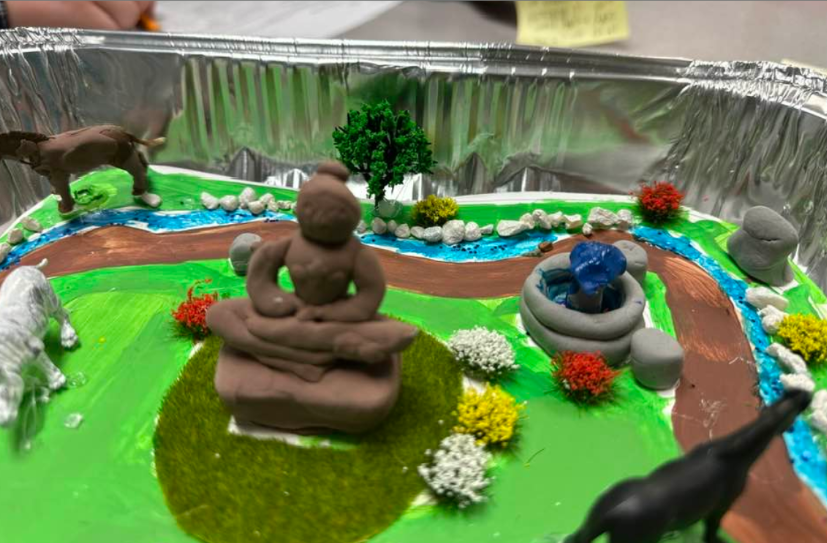
In a nutshell, what it is: students work in small groups to create a model of a garden dedicated to the beliefs and values of a specific world religion/philosophy.
Why we do it: Students benefit from a broader understanding of world views, hone their research skills, and get to collaborate. Plus, it’s super fun to create a tiny world. It just is.
How do we do it?
Step 1: What is culture? What’s so great about it? What’s not so great about it?
This project is the culminating event for an introduction to culture study. It is a pivot between considering the positive aspects of culture such as fostering community, creating identity, strengthening inter-generational bonds, and setting up a shared sense of purpose.
It is also a pivot: after the garden project, we take a look at the not-so-great aspects of culture, including cultural appropriation, stereotypes, cultural conflicts, and, lastly, genocide.
Carefully studying worldviews in the realm of religion and essential philosophies gives the most intimate view of the important questions of humanity: Who are we? What are we even doing here? It is the beginning of understanding why humans behave the way they do.
Step 2: Select, research, plan.
Students tend to want to use their own belief system for their project. In my small, rural corner of North Carolina, the dominant religion is Christianity, more specifically, Protestant, and even more specifically: Southern Baptist. So, in order to allow for an array of religions/philosophies for us to learn about and to be fair, we use the wheel of names. I load the wheel with 8 or 9 world religions/philosophies, and each group spins to select.
Next, students begin work on a research document. They are required to first find a location that fits their religion/philosophy. Then, they research both the geography and climate of their area along with their religion/philosophy’s major beliefs, tenets, and practices. They are required to name the kinds of flowers, plants and trees that are naturally found in their geographic location.
Step 3: Plan, design, and build!
Students will work together to create a plan for their garden by simply sketching it out on a piece of paper. They must include: a pathway for visitors to walk on, seating areas or benches for visitors to meditate, reflect, or simply rest, and at least one 3-D element–most choose to complete several 3-D objects including statues, temples or shrines, trees and other plants, fountains, and other pieces that reflect the beliefs and values of their religion/philosophy. Before they can begin work on the model, they have to explain their design to me. I ask, “What are the major beliefs and values in this religion/philosophy? How are you representing these in your garden?”
Once their design has been approved, they are given a piece of white posterboard and an aluminum casserole dish. They will begin their project by tracing and then cutting out a piece of posterboard to fit the bottom of their foil casserole dish. They then draw a “ground” plan–a sort of blueprint. I remind them that this is the ground–you will draw the base of the statue as it fits to the ground and not the actual statue, for example. They then paint or color.
Next, they build from the ground up. I supply some materials including quick-dry clay, green felt and imitation moss, sometimes tiny, dollhouse-type flowers, popsicle sticks in a variety of sizes, hot glue guns, pipe cleaners, and sturdy pieces of cardstock and masking tape for building.
Step 4: Explanation Page
This is the most important part! Students create a document that offers an introduction to their religon/philosophy, a description of the major features of their garden, with an explanation of how each feature reflects the belief system, and an explanation of how they made sure they were respectful and appropriate with the features of their garden.
I allow students to work as a group to complete these, and I provide the following supports: explanation page helps (with sentence starters) and an example, using a religion/philosophy students didn’t use. I print these out on two different colors of cardstock.
Step 5: Wow! Learn! Reflect!
The garden models are complete, and I have printed out their explanation pages. Everything is laid out in the classroom. Celebration time!
The “wow” part is silent, almost sacred in its own rite. I begin by saying a few words about how important today is–everyone has worked so hard and you’ve learned so much. I tell them why they aren’t to speak during this part–I want them to focus on one of their senses: looking. Looking carefully and closely.
I direct them to first circulate around the room, wordlessly admiring their classmates’ finished projects. After about a minute or two, I have students grab a sticky note or two and give one or two of the projects a little love in the form of a compliment or two.
Next, we learn from the other students. I provide this handout and clipboards. What’s great is that students tend to stay silent–it’s just the feeling in the room–without much prompting from me. They have viewed the models and are truly interested in learning about the belief systems behind them. Finally, students get a chance to reflect on the entire process. While they complete these tasks, I circulate, using a rubric to grade.
In the end, I am thrilled to be done with the messiness of dropped toothpicks, spilled paint, and half-cleaned paintbrushes. But, this project is one I have done twice so far and will do again. It’s super-engaging, and students really learn a lot. Most importantly: it builds respect for other cultures in the minds and the hearts of these young people.

