The MAGIC of Reader’s Theater Part II: Making REALLY Tough Texts Readable

Some time ago, I posted a basic how-to (and why-to!) guide to Reader’s Theater. Few strategies have had a bigger positive impact on building engagement and community in my ELA classroom.

However, it’s important to remember that engagement and community are the first steps toward what we’re really after: comprehension. As ELA/Social Studies teachers, we are committed to helping young readers step into reading material and apply it to a broader context. In short, we want true interaction with the text, not simple compliance. We want to go beyond simply getting the assignment completed.

Engagement: Why it’s Crucial

Done correctly, reader’s theater is highly engaging.In fact, it might be my most successful teaching strategy ever.

If students don’t engage with reading material, they simply won’t learn from it. They won’t advance as readers or learners or critical thinkers. Engagement is everything.

Done correctly, reader’s theater is highly engaging.

I use it in carefully-selected small groups. I sometimes provide a quick (and painless) icebreaker activity or question to get them more comfortable with each other. Something as simple as a quick brainteaser or: “Your first task is to figure out who had the least nutritious breakfast this morning” or “Who in your group woke up the earliest this morning?” can really get them talking.

Self-Selection: How each student gets what they need

After some kind of an opening question or easy group task, students are then directed to scan the reader’s theater script and select which parts they want. Students will select based on their confidence level and this almost always leads to the stronger students doing the heavy lifting. This provides practice for our most able readers–especially if I, the teacher, have selected an above-grade level text. Also, students who struggle will have the additional support of listening to someone else read aloud the words while they follow along.

Important teaching tip: I make it a requirement that students follow along with the script. They aren’t allowed to wait until it’s their turn to read to pay attention.

Comprehension in the Moment: Discussion

I find that students become comfortable enough with each other that they will ask questions about the material as they go. If I find this isn’t happening, I will embed comprehension or discussion questions in the text to answer as they go.

Huge Bonus: The Untangling of Dialogue

Sometimes, we assume that when students read fiction, they can identify which character is saying which line of dialogue. Since lines of dialogue don’t always have dialogue tags, especially when the interaction is between just two characters, this isn’t always the case. Also, some literary texts weave interior dialogue with spoken dialogue, and it can be difficult for a reader to understand what a character is thinking versus what they are saying out loud. For example, in the final chapters of Fahrenheit 451, Montag’s thoughts and what he is saying to Faber are tough to differentiate. So, I create a Reader’s Theater Script that untangles this for them. If I then have them go back to the original text for focused analysis, students begin to learn this skill for themselves. 

Frankenstein: “It’s Alive!”

The first time, I “taught” Frankenstein, I failed. I mean, really. Totally. I wouldn’t even call it teaching. Students struggled and struggled. And struggled. They hated it.

A few years later, I tried again. I knew I loved this novel–how could I invite students in? Especially considering how incredibly antiquated the language was.

The answer was reader’s theater. I created my own scripts and students begged for more. They asked permission to go into the hallway and create videos of their performances. Some later told me Frankenstein was their new favorite novel. 
What’s even better: reading Frankenstein in their reader’s theater groups featured among their best memories of middle school.

I love it; students love it: The Sacred Spaces Model Project

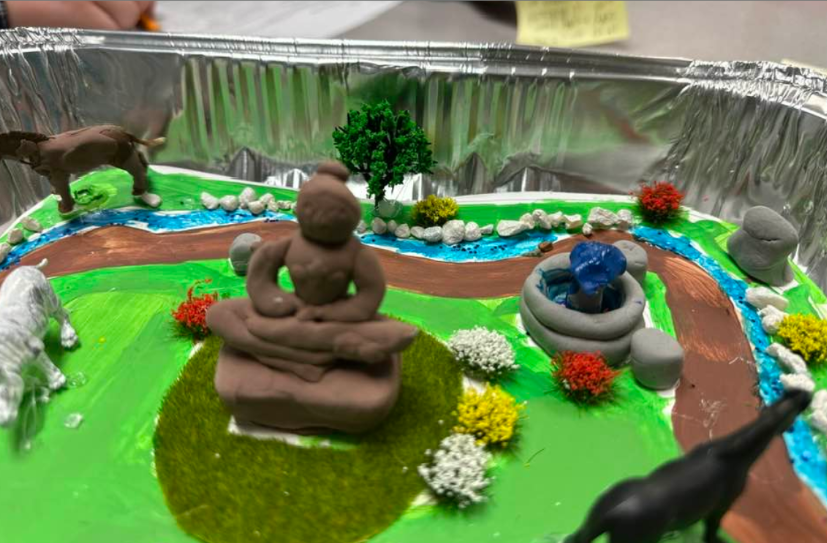
In a nutshell, what it is: students work in small groups to create a model of a garden dedicated to the beliefs and values of a specific world religion/philosophy.

Why we do it: Students benefit from a broader understanding of world views, hone their research skills, and get to collaborate. Plus, it’s super fun to create a tiny world. It just is.

How do we do it?

Step 1: What is culture? What’s so great about it? What’s not so great about it?

This project is the culminating event for an introduction to culture study. It is a pivot between considering the positive aspects of culture such as fostering community, creating identity, strengthening inter-generational bonds, and setting up a shared sense of purpose.

It is also a pivot: after the garden project, we take a look at the not-so-great aspects of culture, including cultural appropriation, stereotypes, cultural conflicts, and, lastly, genocide.

Carefully studying worldviews in the realm of religion and essential philosophies gives the most intimate view of the important questions of humanity: Who are we? What are we even doing here? It is the beginning of understanding why humans behave the way they do.

Step 2: Select, research, plan.

Students tend to want to use their own belief system for their project. In my small, rural corner of North Carolina, the dominant religion is Christianity, more specifically, Protestant, and even more specifically: Southern Baptist. So, in order to allow for an array of religions/philosophies for us to learn about and to be fair, we use the wheel of names. I load the wheel with 8 or 9 world religions/philosophies, and each group spins to select. 

Next, students begin work on a research document. They are required to first find a location that fits their religion/philosophy. Then, they research both the geography and climate of their area along with their religion/philosophy’s major beliefs, tenets, and practices. They are required to name the kinds of flowers, plants and trees that are naturally found in their geographic location.

Step 3: Plan, design, and build! 

Students will work together to create a plan for their garden by simply sketching it out on a piece of paper. They must include: a pathway for visitors to walk on, seating areas or benches for visitors to meditate, reflect, or simply rest, and at least one 3-D element–most choose to complete several 3-D objects including statues, temples or shrines, trees and other plants, fountains, and other pieces that reflect the beliefs and values of their religion/philosophy. Before they can begin work on the model, they have to explain their design to me. I ask, “What are the major beliefs and values in this religion/philosophy? How are you representing these in your garden?”

Once their design has been approved, they are given a piece of white posterboard and an aluminum casserole dish. They will begin their project by tracing and then cutting out a piece of posterboard to fit the bottom of their foil casserole dish. They then draw a “ground” plan–a sort of blueprint. I remind them that this is the ground–you will draw the base of the statue as it fits to the ground and not the actual statue, for example. They then paint or color.  

Next, they build from the ground up. I supply some materials including quick-dry clay, green felt and imitation moss, sometimes tiny, dollhouse-type flowers, popsicle sticks in a variety of sizes, hot glue guns, pipe cleaners, and sturdy pieces of cardstock and masking tape for building.

Step 4: Explanation Page

This is the most important part! Students create a document that offers an introduction to their religon/philosophy, a description of the major features of their garden, with an explanation of how each feature reflects the belief system, and an explanation of how they made sure they were respectful and appropriate with the features of their garden.

I allow students to work as a group to complete these, and I provide the following supports: explanation page helps (with sentence starters) and an example, using a religion/philosophy students didn’t use. I print these out on two different colors of cardstock. 

Step 5: Wow! Learn! Reflect!

The garden models are complete, and I have printed out their explanation pages. Everything is laid out in the classroom. Celebration time!

The “wow” part is silent, almost sacred in its own rite. I begin by saying a few words about how important today is–everyone has worked so hard and you’ve learned so much. I tell them why they aren’t to speak during this part–I want them to focus on one of their senses: looking. Looking carefully and closely.

I direct them to first circulate around the room, wordlessly admiring their classmates’ finished projects. After about a minute or two, I have students grab a sticky note or two and give one or two of the projects a little love in the form of a compliment or two.

Next, we learn from the other students. I provide this handout and clipboards. What’s great is that students tend to stay silent–it’s just the feeling in the room–without much prompting from me. They have viewed the models and are truly interested in learning about the belief systems behind them. Finally, students get a chance to reflect on the entire process. While they complete these tasks, I circulate, using a rubric to grade. 

In the end, I am thrilled to be done with the messiness of dropped toothpicks, spilled paint, and half-cleaned paintbrushes. But, this project is one I have done twice so far and will do again. It’s super-engaging, and students really learn a lot. Most importantly: it builds respect for other cultures in the minds and the hearts of these young people. 

Home*Research*Home Again: Cultural Diffusion Lesson Plan

This week in Social Studies, we’re evaluating the positive and negative effects of cultural diffusion. I like to get students moving, researching, and talking.

Step 1: Engage via a “mystery object” class starter. Students are instructed to write down what they think the object is when they think they know it. I tell them to cover their guess so no one else can steal it. Then, as we get close to the last slide and students are writing and covering, I scurry about the room, checking their answers and celebrating. Students take notes on what cultural diffusion is and list two ways it is spread.

Step 2: Explore via a gallery-walk style scavenger hunt in the hallway. Students collect answers and begin to ponder what the positive and negative effects of cultural exchange around the world might be.

Step 3: Time to explore via research and explanation using a jigsaw strategy. Students create their own “home” groups, then assign research topics. They then move to meet with their research groups to create definitions and examples. Finally, back to their home groups to explain the information and guide the group in coming up with their own example. They do two rounds of this process: one for the positive effects and one for the negative effects.

For the positive effects, I use two different resources: one for grade 6 (ancient history) and one for grade 7 (since 1400).

Step 4: Evaluate! First, we practice together. (Bonus ELA skill: selecting the strongest and the least relevant support for a claim.) Then, solo writing with support in the form of a mini essay.

Kendrick Lamar, Winnie the Pooh, or Voltaire?

Here’s a sneaky way to get students to analyze snippets of primary text: Who said it: Kendrick Lamar, Winnie the Pooh, or Voltaire?

This activity instantly engages minds and activates conversation. And, it’s trickier than it seems: Kendrick Lamar and Voltaire actually agree quite a bit about the state of the world and the rights of individuals.

I am using this as my seventh graders study the Age of Enlightenment, but you could do this with any historic or contemporary figure.

I have done this before with quotations from Superman and Tolstoy, as a way of introducing Tolstoy’s short story, “The Three Questions.” For that one, I set it up as a google slides presentation and had students “vote with their feet”–If you think it was Superman, move to this side of the room; if you think it was Tolstoy, move to the other.

There are many different ways to create this activity. I have simply done an internet search: “list of quotations by (person)”. More recently, I have used chatgpt, but if you go this route, you have to watch out for errors. I found that asking chatgpt to fact-check itself helped me fix some of these mistakes.

This exercise lends itself to a number of writing exercises. Students can, for example, select a quotation and write a short paragraph explaining what the quotation means and whether or not they agree. It could launch a research paper comparing and contrasting the two (or three) figures and/or the new ideas they introduced to the world. Or, you could take a more creative approach and have students create a talk show featuring the quoted persons or use the quotations to launch a debate.

Essentially, the question is (ALWAYS!): How can a single idea change the world?

Engage: Agree/Disagree Walkaround

Here’s a quick activity to get students interacting with each other and talking about big ideas.

How to set it up:

  1. Create 9 agree/disagree statements aligned with your current or upcoming topic of study.
  2. Create a student paper with a grid 3 x 3. You will add one agree/disagree statement to each box. You will also add a space where students can write the name of a partner and their thoughts on the agree/disagree statement.
  3. Students will then move around the room, completing the grid. Instruct students to chat first about the agree/disagree statement, being sure to ask your partner their opinion and offering yours as well. Students should not write down their own opinion until they’ve chatted with their partner–discussing an idea with someone else just might change your mind!
  4. You may choose to follow this activity with a short independent writing assignment in which students select one of the agree/disagree statements to write a paragraph response to. This is a great way to get students writing–they’ve already spent some time thinking about the statements and have practiced explaining their thoughts.

Here’s a link to an Agree/Disagree Walkaround I shall use this coming week to launch a study of government: Government: What is it? Why do we need it?

You can use it as is or make a copy and then edit it to fit your needs. Please feel free to get in touch with me if you would like some help adapting this activity to your classroom.

Step-by-Step: Building Paths for Individualized Learning

I begin each year with the best of intentions. I make my little pacing guide. I map out the year: what I will “cover” each quarter. Every student will master x in quarter 1, y in quarter 2, and so forth. Easy-peasy, right? 

Ummm…no. This is just not how learning works. 

There is nothing wrong with having a pacing guide–you need a plan. 

However, if all you’re doing is checking standards off without really focusing on authentic learning or accounting for individual student needs, you need to make some changes.

Some years ago, I came to this very realization. Stop “covering” the standards, and start teaching the kids. 

So, here, then are the questions:

  • How can I determine what my students need?
  • How can I create a series of learning experiences that will take them from where they are to where they need to be?
  • How do I personalize these learning experiences, differentiating for ability, learning modalities and preferences, personal interests, cultural considerations, etc.?
  • How can I do all this for ninety-some students and not lose my mind?

The fact is that our goal for all of our students is largely the same: we want them to grow up to be competent, literate participants in our democracy. We want them to enjoy literature and glean some wisdom from it. We want them to be savvy readers of informational and so-called “news” texts, identifying bias and flaws in logic. We want them to question: Where did this information come from?

Most importantly: We want to give our students the power to express themselves. We want to give them their voice.

However, every student is different. Some of them mastered the skill of finding the main idea in the third grade and yet we keep teaching it to every student every year. Other students didn’t grasp this concept back in the third grade, and every year we reteach it in largely the same way and they still don’t get it.

Maybe they don’t have the prerequisite skills of basic comprehension.

So, how do we back up and find and then teach from the place of actual need for every student? 

The following is my version of a planning method called backward design.

Step 1. Determine the end goal. What is the standard you’re addressing? How will you know when students have mastered this standard? 

Step 2: Pre-assess. You have to know where students are before you can begin. (I wrote about how and why to use pre-assessments here.)

Step 3: You will evaluate the results of the pre-assessments, then reate a pathway–a series of assignments, instruction, and other learning activities–to help them get from where they are now to where they need to be, as determined in Step 1.

Here is a pathway I created for the following objective:

Students will analyze how writers use figurative language to create tone, which in turn helps create mood.

I might begin by using the introductory slides as mini-lessons, then allow students to work independently or in small groups through the rest of them, with me checking in on students’ progress, always thinking about what other supports students might need along the way.

Part 1: Figurative Language to Tone

Part 2: Tone to Mood Practice

Part 3: Tone to Mood to Theme in a Literary Text

Step 4: Flexible Grouping

Put students in groups. The group with the most need will begin with the first step on the pathway you’ve created. Position all of the other groups to places along the same pathway where they need to begin. So, this means some students will skip the first few steps of the pathway. Some will skip all of them. If this is the case, you will need to find or create learning experiences that lead students into deeper analysis of the study at hand, or you might lead them on to a new skill.

Here are some more thoughts on how and when to use flexible grouping. 

Step 5: Feedback

Provide frequent opportunities to evaluate and provide personal feedback–here is where the truly personalized part comes in. 

Here is a fabulous Edutopia blog post about the power of feedback–especially individualized feedback–and how it can empower students.

Classroom Management: The Sticky Solution

So much about teaching comes down to personality. Or, rather: it begins with personality. As I have written about here, we teach from the inside out.

I believe this is also true about classroom management. Just like lesson plans and creating a supportive classroom culture, one should sample others’ ideas, but then select and adapt to fit you, your students, and the overall culture of not only your classroom and school, but also the community you live and teach in.

I think it’s useful, however, for every teacher to consider the following questions:

  • What is the purpose of classroom management?
  • What are my expectations? Are these expectations realistic? Reasonable?
  • How can I create a system of addressing behaviors and conflicts that allows my students to feel safe physically and emotionally?
  • How can I adapt the physical space in my classroom to support positive interactions and learning?
  • How does the culture of my classroom work to support my classroom management system?

Here is the method I have developed over the last couple of years. These ideas are not mine, but adapted from conversations, examples, and little tidbits I’ve picked up over the years.

I also have chosen a system that works well with my personality and teaching style. It’s important to me that I avoid judging students or shaming them: helping students correct behaviors so they can be successful in a community is part of educating them.

Step 1: The One-Rule Classroom.

I’m sure you’ve seen this; it’s all over teacher Pinterest boards. I have tried to track down its origins with no luck. I like it because it’s simple, it’s positive, and it emphasizes the true purposes behind classroom management: If what you are doing interferes with learning, hurts someone’s heart, or prevents you from being your best self, you shouldn’t be doing it.

At the beginning of the year, I post this and ask students to help me think of example behaviors for each part. I also ask them to imagine an undesirable behavior that this rule doesn’t cover. So far, none of my students have managed to do so.

Step 2: Introduce the Sticky Solution

Here’s what I say:

If you are hurting someone’s heart, I will remove you from the classroom immediately. I will not tolerate this kind of behavior. Ever.

For other infractions of this rule–and especially for disruptive behaviors–I will use a sticky note as a warning. I will simply place a blank sticky note on your desk. This means you need to stop doing whatever you’re doing.

If the behavior stops, nothing happens. Just throw the sticky away on your way out of class.

If the behavior continues, I will ask you to write your name on the sticky. And, again, if the behavior stops now, you will take this sticky with your name on it and just throw it away at the end of class.

If, however, the behavior continues, I will collect the sticky and add you to my list of lunch detention, or I might pull you out of class to complete a behavior reflection form. That’s up to me. I will use my judgment and make the best decision I can.

I will always listen to your side of things, though. I want you to know that I know that I don’t always see everything. You can always tell me what I need to know to better understand the situation.

You can always tell me if you’re struggling with something, or if you’re afraid.

After the behavior is addressed through detention, a little talk, or completing the behavior form, it’s over. All is forgiven. We move on, learning and having fun together.

And I will always like you and be in your corner, even when I am not pleased with your behavior. I promise.

What questions do you have?

That’s it. That’s what I do.

It usually works. In fact, typically, if I just pick up my little pad of stickies, students adjust their behaviors right away.

One more thing…

Of course, every child is different. Every situation is different. We teachers have such an incredible power here. We can choose to use these situations to help students grow or we can use them to belittle students and shut them down.

I heard this once some years ago, and it’s important to remember: It’s not about you.

Don’t take student misbehavior personally. Don’t punish them because it makes you feel better. We are all human with the very human gut-reaction to do both of these.

But, that approach just won’t work. It’s not about you. It’s not about me. It’s the kids. It’s always the kids.

Reader’s Theater: Why, What, and How

It’s magic.

It instantly engages students. They are fully immersed in the text. They are acting it out; they are living it. They become the characters as they portray them.

It makes learning social.

It leads to the kind of discussion and outloud thinking that supports comprehension in the moment and builds good reading-and-thinking habits for future, independent reading.

It has built-in, completely organic and student-driven differentiation. Students select their roles. The competent, confident readers generally take on the parts with more speaking. Those who are not as strong with reading out loud will choose the smaller parts.

Everyone gets practice. Increases fluency for all.

Bonus: Those who struggle the most will benefit from hearing the words spoken aloud as they follow along. This helps them internalize things like intonation and phrasing. Students learn how to “scoop up” meaning: sentence-wise and phrase-wise.

And this: students love it.

What is Reader’s Theater?

Reader’s Theater, first developed for the classroom in the 1950’s, is a reading activity where students read aloud scripts adapted from a narrative text. Students are seated. They are instruted to “act from the waist up” which means they will use voice and intonation along with facial expressions and body language to convey meaning and emotion.

While reader’s theater traditionally involves a group of students who have assigned parts sitting on stools or chairs in the front of the room, performing for the rest of the class, I have found it works best in small groups. If you walk into my classroom during reader’s theater, you will find several small group performances happening at different tables all around the room.

I prefer to approach it this way because it means every student gets to read at least one part. Also, shy kids feel more at ease participating in a small group. And, I have found that if they work like this, they will often stop and talk about what’s happening–spontaneous collaborative discussion!

How do I set up reader’s theater in my classroom?

  1. You will need a digital copy of the text that you have editing access to. I find it usually works just fine to copy and paste a pdf onto a google doc. (Just make sure the work is in the public domain. Just about anything on commonlit falls into this category.)
  1. You will edit the text, turning every sentence and paragraph into a script. You will assign all exposition–anything a character isn’t actually saying out loud–to a narrator. 

To ease the burden of this part, I generally have 2-3 narrators per script. (Bonus! This helps with comprehension by breaking up long exposition and description passages.)

  1. You will change every line of dialogue to a script, deleting phrases like “(character name) said” and all quotation marks. You will put stage direction in parentheses.

For example:

(original text)

Martha sighed. “What in the world is wrong with you, Mortimer?”

Mortus wiggled in his seat. He said, almost too quietly for anyone to hear, “Wouldn’t I like to know.”

(reader’s theater script)

Martha (sighing): What in the world is wrong with you, Mortimer?

narrator 1: Mortimer wiggled in his seat.

Mortimer (very quietly): Wouldn’t I like to know.

4. Create a parts page. Here’s an example, from Roald Dahl’s “Lamb to the Slaughter”. I have these set out on the tables, along with the scripts, when students first enter the classroom. They begin by parceling out the parts. 

If they are taking a bit too long with this step, I will help them settle their decisions. It’s important to have the scripts available to students so they can see how much talking they will be doing for each part. I have found that students generally self-differentiate here: Strong readers will pick meatier parts. Struggling readers will choose a part with fewer lines.

5. Project directions. (If this is your class’s first time performing Reader’s Theater, it might be useful to discuss these steps and to possibly have a few students model them for the class.)

6. Students begin reading! During this time, I walk around the room, making sure students are following along on the script as others read. I also will try to make sure everyone can hear everyone within their groups. Sometimes, I have to encourage students to speak up, or–if the entire classroom is too loud–I will let a group of students that I can trust to work on their own slip out into the hallway.

This is students’ first time reading the story. I want them to experience it “in real time” and with each other. Students will often, unprompted, engage in the very kind of discussion/thinking you’re wanting them to: predicting, making inferences, analyzing character motivation, and offering their opinions on the different characters’ decisions.

Follow-up: Next Steps

Reader’s Theater is a student’s first step into a literary text. I follow this up with independent reading and annotating, with analysis.

In my classroom, Reader’s Theater is a scaffold, supplying students with a first glimpse of a story. During Reader’s Theater, I am looking for “hooking” students and giving them an overview of the story before we dive in to the actual, non-Reader’s Theater text, for a more thorough read.

I hope you’ll try this activity. My students absolutely love this. They come to class, begging for Reader’s Theater!

Learning Happens Day 1: Non-Fluff Icebreakers

Icebreakers! To some, they’re a necessary evil. To others, they are the best thing ever. I love facilitating them in my classes, but I hate having them forced upon me. Hello, first staff meeting of the year!

I don’t like putting myself in a socially vulnerable position in a place where I don’t know people and therefore don’t feel safe.

They also feel like a colossal waste of time. It’s the beginning of the year! Quit making me tear off toilet squares and let me get into my room or–even more important–my planning desk.

But, I know we need to do something to build community and get our rah-rah-team thing going. And, when it comes to my classroom, what else are we going to do the first of the year? Nobody’s ready for a full-on lesson. (Especially me!)

And, really, really and truly: I can’t start teaching until I know who I’m teaching.

So, I have scavenged the net and created/adapted a few ice-breakers that begin the work of building community and help us get to know each other while not putting any one student on the spot. They get the right vibe going. AND, they actually teach a little something.

Here are my two favorites.

Tell me: Who are you? (Or…who aren’t you?)

You need to prep by printing out these personality traits vocabulary cards. You will cut them out, and then tape them to student desks.

As students enter, you will instruct them to walk around the room, reading the different cards before taking a seat. They will then choose a word that either describes them perfectly OR is the exact opposite of who they are.

If you have tables for seating or if desks are arranged in groups, you will then have students introduce themselves in their groups, explaining why they are or aren’t the personality trait marked on their desk. Students should then pick a spokesperson from the group to introduce the group members to the class.

If the desks are arranged in rows, you can instead have students turn and talk, introducing themselves to each other. You can then call on volunteers to introduce themselves and their partner.

Either way, you will circulate while students are chatting, and get to know your students.

This is a useful activity because it gets students talking to each other–and they’re actually teaching each other vocabulary words. It also gets them started explaining their thinking: Why did you chose this word? Is there another word that you also considered? Also, it’s more challenging than most ice-breakers, and challenging activities–challenging but not frustratingly hard–really ramp up student engagement.

On day 2, as a follow-up, you will create a gallery walk using these questions. Students are asked to answer 3 of the questions with a sticky note. They can begin with the word “yes” or “no” but then have to justify their answers.

You will then direct students to select a question they found especially intriguing. Be sure to set a max number of students per group. Students will then work in their groups to arrange the answers to the questions and prepare to give an overview of these responses to the class.

Once again, this activity gets students talking to each other and discussing their ideas , which promotes classroom community and elevated discourse. As a bonus, they are not only learning new vocabulary words, but they are doing some solid thinking about the distinctions between the words.

Who’s your G.O.A.T.?

Here’s another non-fluff ice-breaker that encourages discussion and teaches students how to build an argument: What or who is the GREATEST OF ALL TIME?

You will begin by pairing students up. You can do this yourself, or you can ask them to find a person they haven’t spoken to so far today. I pair students up like this throughout the year. Or, if you’ve already done the personality traits vocabulary activity above, you can pass out slips of paper. Half will have a vocabulary word on them. The other half will have the definitions. Students are then tasked with finding their match.

Then, you will give each partnership this handout. Students will follow directions: first brainstorming, then selecting a common G.O.A.T., and lastly preparing an argument to present to the class. Like the activity above, this gets students talking about themselves while also learning important skills–brainstorming, collaboration, and building an argument.

One way to introduce this activity is by creating a list of your own personal G.O.A.T.’s. Mine include Tom Petty, Taco Bell, and Brooklyn 99. Ask students what they notice about the list and what they think all the items have in common before revealing–these are the GREATEST OF ALL TIME! Then, you’ll select one from your list and provide a mini-argument on why Taco Bell is the best thing out there.

Now, you’ve shared about yourself and have modeled the activity.

Both of these activities set the stage for skills they’ll continue to develop all year. They are also fun and do not involve a single square of toilet paper.

link to more ideas + ready-to-go resources on my TPT store